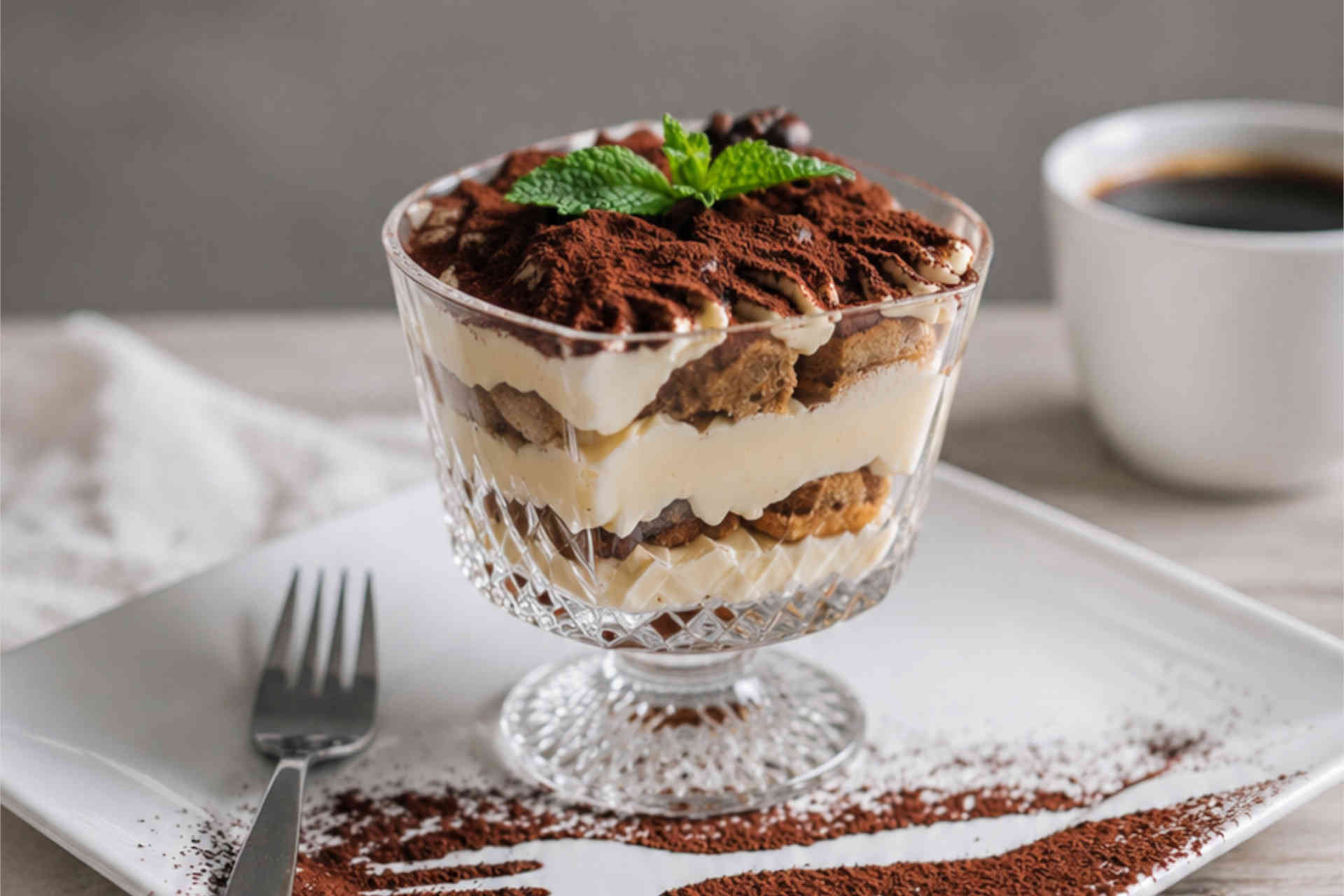
Original italienisches TiramisuPhoto: Alexandra Gorsche | KI-gestützte Bildbearbeitung
Authentic Italian Tiramisu: A Family Recipe from Chioggia
Alcohol-Free and with a Gluten-Free Option
Sometimes, the best recipes are discovered when you are not looking for them at all. In our case, it all began with a boat trip through the lagoon of Chioggia and ended just a few days later in the kitchen of an Italian who introduced us to the secrets of his family's treasured tiramisu recipe, passed down through generations. No rum, no amaretto, no whipped cream. Instead, exceptionally good espresso, quality mascarpone, airy whipped egg whites and a few small but essential techniques. Ever since, this has been my favourite way to prepare tiramisu.
From the Venetian Lagoon to an Italian Home Kitchen
Originally, we simply wanted to discover Chioggia from the water. This small fishing town at the southern end of the Venetian Lagoon, often referred to as “Little Venice”, has a charm all of its own. Less glamorous, wonderfully down-to-earth and brimming with Italian joie de vivre. We embarked on a boat tour with Damiano from Bosetti Tours. Yet sometimes, it is the unexpected encounters along the way that leave the most lasting impressions. A boat trip turned into a new acquaintance, and that acquaintance soon led to an invitation into his private kitchen. Just a few days later, we found ourselves at Damiano's home, learning how tiramisu is prepared in his family. This was not a recipe staged for tourists, but one that had long been part of his family's culinary traditions. These are precisely the encounters I love most about travelling. While sightseeing can be planned and restaurant reservations made in advance, such personal insights into a country's culinary culture are almost impossible to organise. They simply happen. And sometimes, the most beautiful souvenir you bring home is not something you buy, but a recipe.
Tiramisu Without Alcohol? Absolutely!
Growing up, I remember tiramisu being made with rum, amaretto or other alcoholic ingredients. For a long time, I simply associated those flavours with the classic Italian dessert. That made Damiano's entirely alcohol-free version all the more surprising. And I have to admit: I now prefer it this way. Leaving out the alcohol allows the espresso, mascarpone and cocoa to shine. Each ingredient contributes its own distinctive flavour without being overshadowed by an additional spirit. The secret of this family recipe lies not in an extensive ingredient list, but in the quality of the ingredients and the preparation techniques. The fewer ingredients a recipe requires, the fewer places there are for mediocre quality to hide.
Savoiardi: Why Choosing the Right Ladyfingers Matters
Damiano used the classic Italian Vicenzovo Savoiardi by Matilde Vicenzi for his tiramisu. These traditional Italian ladyfingers are ideal for layering, as they absorb the espresso while retaining their structure when dipped correctly. For my own version, I used gluten-free ladyfingers. And the best part? There is absolutely no compromise on flavour.
These are three gluten-free alternatives I particularly recommend:
- Schär Savoiardi: A convenient option, as they are relatively easy to find in many supermarkets and specialist food stores.
- Vicenzovo Senza Glutine by Matilde Vicenzi: The gluten-free alternative to the traditional Italian ladyfingers Damiano used.
- Inglese Savoiardi Senza Glutine: Another excellent Italian alternative with a particularly convincing flavour.
Whichever variety you choose, the key is to dip the ladyfingers into the espresso only very briefly. They should absorb the coffee's aroma, not drown in it.
Why I Prefer Serving Tiramisu in Individual Glasses
Of course, this tiramisu can be prepared in a large dish in the traditional way. My personal favourite, however, is serving it in individual dessert glasses. The delicate layers are beautifully displayed, the dessert can be prepared well in advance, and serving is wonderfully uncomplicated. It also eliminates the challenge of extracting that first slice of tiramisu from the dish without causing a minor culinary disaster. And if one glass is not enough, simply have two. Italian joie de vivre really can be that uncomplicated.
My Verdict: Few Ingredients, Plenty of Italy
This tiramisu reminds me that the best recipes are not necessarily the most spectacular ones. Often, they are the recipes that have been passed down through families, prepared countless times and perfected with a great deal of intuition. For me, this dessert now tastes not only of espresso, mascarpone and cocoa, but also of Chioggia, the Venetian Lagoon and the wonderful hospitality of an Italian we originally met simply because we wanted to go on a boat trip.
Preparation
Prepare the espresso
- 1
Brew a high-quality espresso and dilute it with a little water.
- 2
Allow the coffee to cool completely before pouring it into a shallow dish large enough to dip the ladyfingers comfortably.
Prepare the mascarpone cream
- 1
Separate the egg. In a clean, grease-free bowl, whisk the egg white until stiff peaks form.
- 2
In a separate bowl, beat the egg yolk until light and frothy.
- 3
Add the granulated sugar and continue whisking until the egg yolk and sugar mixture becomes noticeably paler and creamy.
- 4
Add the mascarpone and continue mixing until the cream is smooth, airy and very pale in colour.
- 5
Using a spatula, carefully fold in the whipped egg white. Cut through the centre of the mixture with the spatula, scoop the cream up from the bottom of the bowl and gently fold it over the egg white. Rotate the bowl slightly as you work.
- 6
Repeat until the whipped egg white is evenly incorporated into the mascarpone cream. Avoid vigorous stirring to preserve as much air as possible.
Assemble the tiramisu in individual glasses
- 1
If necessary, break the ladyfingers into smaller pieces so that they fit neatly into the prepared dessert glasses.
- 2
Very briefly dip each ladyfinger into the cold espresso. Simply turn it once on each side and remove it immediately.
- 3
Arrange a layer of coffee-dipped ladyfingers at the bottom of each dessert glass.
- 4
Cover with a layer of mascarpone cream.
- 5
Add another layer of ladyfingers, followed by another layer of cream.
- 6
Repeat, depending on the size and height of the glasses. Always finish with a layer of mascarpone cream.
Chill and serve
- 1
Cover the glasses and refrigerate for at least four hours. When prepared with pasteurised eggs, the tiramisu can also be made the day before and left to chill overnight.
- 2
Just before serving, dust the surface with unsweetened cocoa powder using a fine-mesh sieve.
- 3
Serve well chilled and enjoy.
The perfect formula for Italian tiramisu
If you want to prepare this recipe for more people, there are only three numbers you need to remember: 1 – 125 – 25.
- 1 egg, 125 g mascarpone, 25 g sugar, approx. 2–3 portions
- 2 eggs, 250 g mascarpone, 50 g sugar, approx. 4–6 portions
- 3 eggs, 375 g mascarpone, 75 g sugar, approx. 6–9 portions
- 4 eggs, 500 g mascarpone, 100 g sugar, approx. 8–12 portions
- 6 eggs, 750 g mascarpone, 150 g sugar, approx. 12–18 portions
- 8 eggs, 1,000 g mascarpone, 200 g sugar, approx. 16–24 portions
The quantity of ladyfingers and espresso will depend on the size of the glasses and the number of layers.
Ladyfingers need a quick coffee dip, not swimming lessons
One of the most important lessons I took away from Damiano's kitchen was how to dip the ladyfingers. Savoiardi should never be left sitting in the espresso. Instead, they should be quickly turned once on each side and removed immediately. During the chilling process, moisture continues to distribute throughout the ladyfingers. If they are already completely saturated with coffee during preparation, the finished tiramisu may become excessively soft and watery. It is worth being particularly careful with gluten-free ladyfingers, as their absorption rates can vary depending on the manufacturer.
Good espresso is non-negotiable
In an alcohol-free tiramisu, coffee plays a particularly important role in shaping the flavour. A well-balanced, aromatic espresso forms the foundation of the dessert's distinctive character. I would therefore always recommend choosing a coffee that you would genuinely enjoy drinking on its own. Diluting it with a little water makes it ideal for dipping the ladyfingers without allowing the coffee flavour to become overpowering. It is also essential to let the espresso cool completely before dipping the ladyfingers.
Lightness comes from patience, not speed
When it is time to incorporate the whipped egg whites, put the electric mixer aside. A spatula and a little finesse are all you need. Gently folding in the egg whites preserves as many of the tiny air bubbles created during whisking as possible. These are what give the mascarpone cream its wonderfully light and airy texture, despite the richness of the mascarpone itself.
Why cocoa powder should always be added at the very end
If you dust the tiramisu with cocoa powder before refrigerating it, the cocoa will absorb moisture from the cream as the dessert rests. As a result, it darkens and loses its delicate, powdery appearance. When freshly applied, the cocoa remains dry and aromatic, creating a beautiful contrast with the pale mascarpone cream. A small detail that makes a considerable difference, both visually and in terms of the overall tasting experience.
Gluten-free without compromising on flavour
This tiramisu is one of those desserts that can be adapted to a gluten-free diet with very little effort. The mascarpone cream remains exactly the same; simply replace the traditional Savoiardi with gluten-free ladyfingers. When preparing the dessert for someone with coeliac disease, make sure that all other ingredients are also gluten-free and take care to avoid cross-contamination.
Pay attention to egg quality and food safety
As the eggs in this tiramisu are not cooked, I recommend using pasteurised eggs or a combination of pasteurised egg yolks and pasteurised egg whites suitable for whipping. This helps reduce the risk of salmonella without compromising the traditional preparation method. Refrigerate the tiramisu immediately after preparation, keep it chilled throughout storage and consume it promptly.